
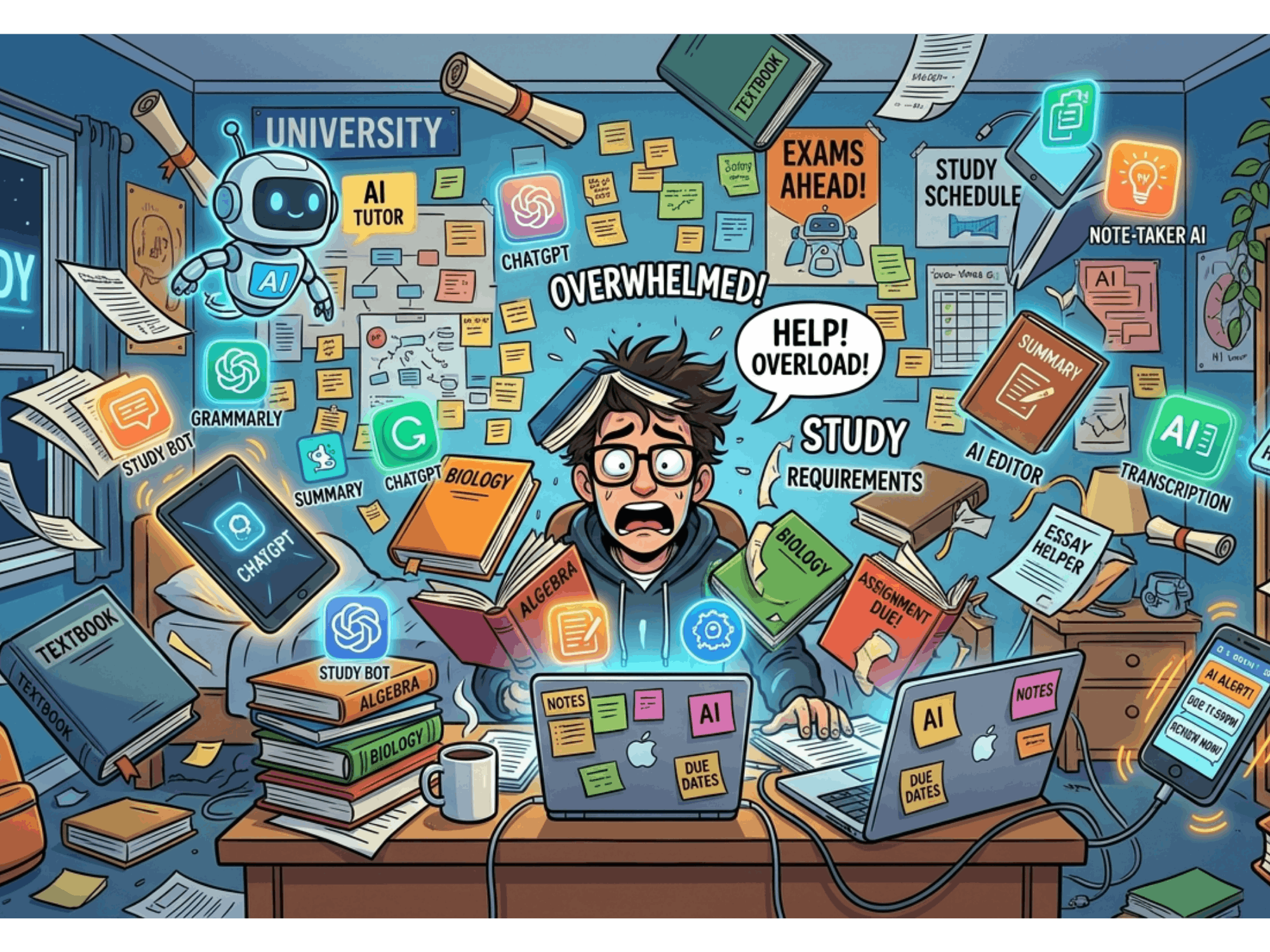
Many college students are asking the same question: Why does studying feel harder now, even with more tools and resources available?
You have lecture recordings, LMS portals, PDFs, group chats, online study tools, and even AI assistants. Yet focusing feels harder. Retaining information feels inconsistent. And preparing for exams often feels overwhelming.
If you have searched for "how to study effectively," "how to focus while studying," or "best way to retain information for exams," you are not alone.
The issue is not effort. It is structure.
The College Information Overload
Modern students are not just reading textbooks. They are managing:
- Canvas or Blackboard LMS exports
- Recorded lectures
- Slide decks
- PDF readings
- Email updates
- Shared notes
- Study group threads
Each platform contains part of the material, but few of them contain all of it.
This creates a form of information overload in college that is different from the past. Instead of struggling with a single textbook, students are navigating fragmented knowledge across multiple systems.
Research on cognitive load shows that when the brain is busy managing information sources, it has less capacity for deep understanding.
In other words, switching between tabs is not harmless. It reduces learning efficiency.
Why Rereading Is Not the Best Study Method
When exams approach, many students default to rereading notes, highlighting PDFs, or watching lectures again. These strategies feel productive, but they are forms of passive review.
Studies on the science of learning consistently show that passive review is one of the least effective study methods.
More effective techniques include:
- Active recall study method
- Spaced repetition for exams
- Practice testing
- Self-explanation
If you have searched for "best way to retain information" or "how to study for exams faster," you have likely encountered these methods. The problem is not knowing about them. The problem is applying them in a fragmented digital environment.
The Attention Problem
Another factor contributing to why studying feels harder is attention. Digital learning environments increase distractions. Notifications, open tabs, and multiple platforms compete for focus. Even when you intend to concentrate, your brain is constantly shifting context.
This constant switching creates what researchers call attention residue. Part of your focus remains stuck on the previous task. Over time, this makes it harder to enter deep concentration, which is essential for mastering complex subjects.
The Rise of AI Tools for Students
Many students are now turning to AI tools for studying. Searches for "AI tools for students" and "best AI for homework" have increased significantly.
"AI can help summarize notes, explain difficult concepts, and generate practice questions. Used thoughtfully, it can reduce friction and support learning."
However, not all AI tools are equal. When AI pulls information from the open web rather than from your specific course materials, answers may not align with your professor's expectations or your assigned readings. For academic success, alignment is crucial.
What Actually Helps Students Study More Effectively
If studying feels harder today, the solution is not necessarily more tools. It is better organization and smarter methods.
Students who improve retention and exam performance tend to:
- Consolidate materials into one organized system
- Use active recall rather than passive review
- Space out practice over time instead of cramming
- Reduce context switching during study sessions
- Use tools that support their actual curriculum
Structure reduces cognitive load, reduced cognitive load improves focus, and better focus leads to stronger retention.
A Shift From More Information to Better Structure
The modern college experience provides more information than ever before. But more information does not automatically mean better learning. If you are searching for study tips for college students, how to focus while studying, or how to study effectively, the answer may not lie in downloading another app. It may lie in creating a structured, distraction-aware study system that works with your materials instead of scattering them.
"Learning feels harder today because environments are more complex. When structure improves, studying becomes clearer, more manageable, and far more effective."