


IMPLICIT KNOWLEDGE
Software Product & Engineering Knowledge Made Operational
Turn specs, decisions, docs, and team knowledge into an AI system your team actually uses.


The Hidden Burden on Product & Engineering Teams
Modern product teams move fast with constant pressure for new features, rapid iteration, constant architectural change.
But the knowledge behind those decisions is fragile, and often forgotten when moving at a fast pace. It lives across:
- PRs and Slack threads
- Half-maintained docs in Google Drive or Sharepoint
- Senior engineers' heads
- Notion pages (that may or may not be regularly updated)
- The result is constant rework, regressions, slow onboarding, and design decisions made without context.
1.
The Complexity of Modern Software Product & Engineering
A Living Knowledge System for Product and Engineering Teams
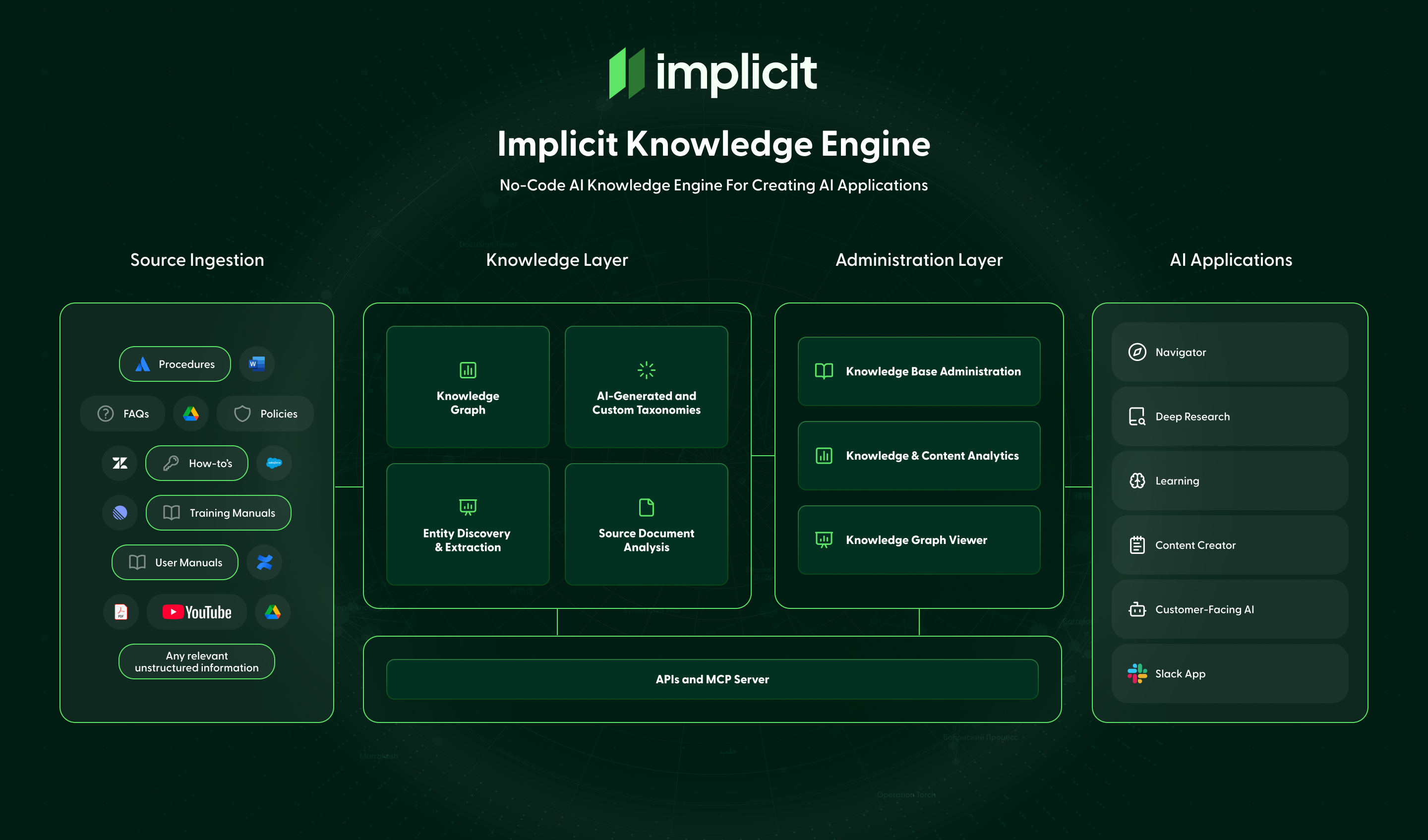
- Implicit is the AI-powered Knowledge Layer built for the reality of modern SaaS.
- Product and engineering teams don’t struggle because they lack documentation. They struggle because knowledge is fragmented and context gets lost. Traditional docs store information, but they don’t preserve understanding, leading to rework, regressions, and the same roadblocks repeating over time.
- Implicit ingests product and engineering artifacts (ie: architecture docs, ADRs, API references, design specs, release notes) and connects them into a structured, queryable knowledge layer. Engineers can ask real questions and get reliable, contextual answers grounded in actual decisions. As the product evolves, the knowledge evolves with it, keeping institutional memory intact and velocity high without constant manual upkeep.
Key Benefits of Implicit for B2B Software Companies
Implicit links decisions to the documents, tradeoffs, and constraints that informed them, keeping rationale intact over time. When questions resurface, teams evaluate whether conditions have changed instead of re-litigating old debates.
Engineers can surface prior solutions, known limitations, and historical edge cases while designing or refactoring. This helps prevent accidental regressions and avoids repeating problems that were already solved.
Implicit doesn’t just regurgitate FAQs—it provides intelligent answers with traceability, perfect for technical audiences.
New engineers can ask how systems work, why decisions were made, and where to find relevant context across docs, specs, and past discussions. This reduces reliance on senior engineers and shortens the time it takes to contribute meaningful code.
Reviewers can reference relevant system history and past decisions directly when evaluating new proposals. This keeps discussions focused on impact and tradeoffs rather than reconstructing context.
New knowledge is absorbed continuously as the product evolves, rather than relying on manual documentation catch-up. Teams move faster without losing clarity or accumulating hidden knowledge gaps.
2.
How Implicit Solves the Support Challenge
Should You Build or Buy Your AI-Driven Support Solution?
(Spoiler: You Should Probably Buy)
- Yes, you've got engineers. Yes, they're brilliant. But building an AI-powered knowledge platform in-house?
- That's a product, not a sprint.
- Meanwhile, Implicit is already live, already trained, and already trusted by technical teams. Plug it in and start delivering value faster than your next retro.
- To realistically deliver this with an internal build you should expect:
Developing an AI-based knowledge graph requires ongoing data processing, NLP modeling, and maintenance, consuming valuable development bandwidth.
AI models must be fine-tuned regularly to keep up with evolving product offerings and customer interactions.
A custom solution could take years to perfect, whereas Implicit delivers immediate value. By leveraging Implicit’s pre-built AI platform, B2B software companies gain instant access to best-in-class AI models trained specifically for support, without diverting internal engineering resources.

3.
Why You Shouldn’t Build It Yourself
Can't We Just Use Notion, Confluence, and GitHub
- (Yes, you can! If you enjoy duct taping workflows.)
- Platforms like Notion, Confluence, and GitHub are great tools that can do a lot of things. But, when it comes to delivering real-time, context-rich information in a complex SaaS environment, they come up short in a few key ways:
These tools are designed to store information not to model how systems actually work. Product and engineering knowledge is relational and evolving, but static pages can’t express dependencies, tradeoffs, or how decisions connect across the architecture.
Lack Engineering-Aware Context
Generic search and chatbot features don’t understand product domains, system boundaries, or technical intent. Without awareness of architecture, dependencies, and historical decisions, answers lack the depth engineers need to make safe, informed changes.
Product knowledge lives across specs, ADRs, PRs, incident reports, and internal discussions, all updated at different speeds. Traditional platforms require manual curation to keep these sources aligned, which inevitably falls behind how fast engineering teams ship.


