
There's a familiar arc playing out with NotebookLM.
At first, it feels like a breakthrough. You upload documents, ask questions, and the answers actually stay grounded in your sources. For research, studying, and making sense of dense material, it is one of the most satisfying AI experiences people have had.
But then something subtle happens. The use case starts to stretch.
What began as "help me understand these documents" slowly becomes "help me use this knowledge to do something." That shift introduces friction. It does not happen because NotebookLM is failing. It happens because people are asking it to operate beyond its design.
What matters is not the limitation itself. What matters is how people adapt.
Users build entire workflows outside NotebookLM to make outputs usable
The first shift usually appears when someone tries to move beyond solo work.
Inside NotebookLM, everything feels clean and contained. However, the moment the output needs to move to a teammate, a workflow, or a decision, the edges become visible. There is no natural handoff layer. There is no built-in way to turn insight into something reusable across a team.
So people start building around it.
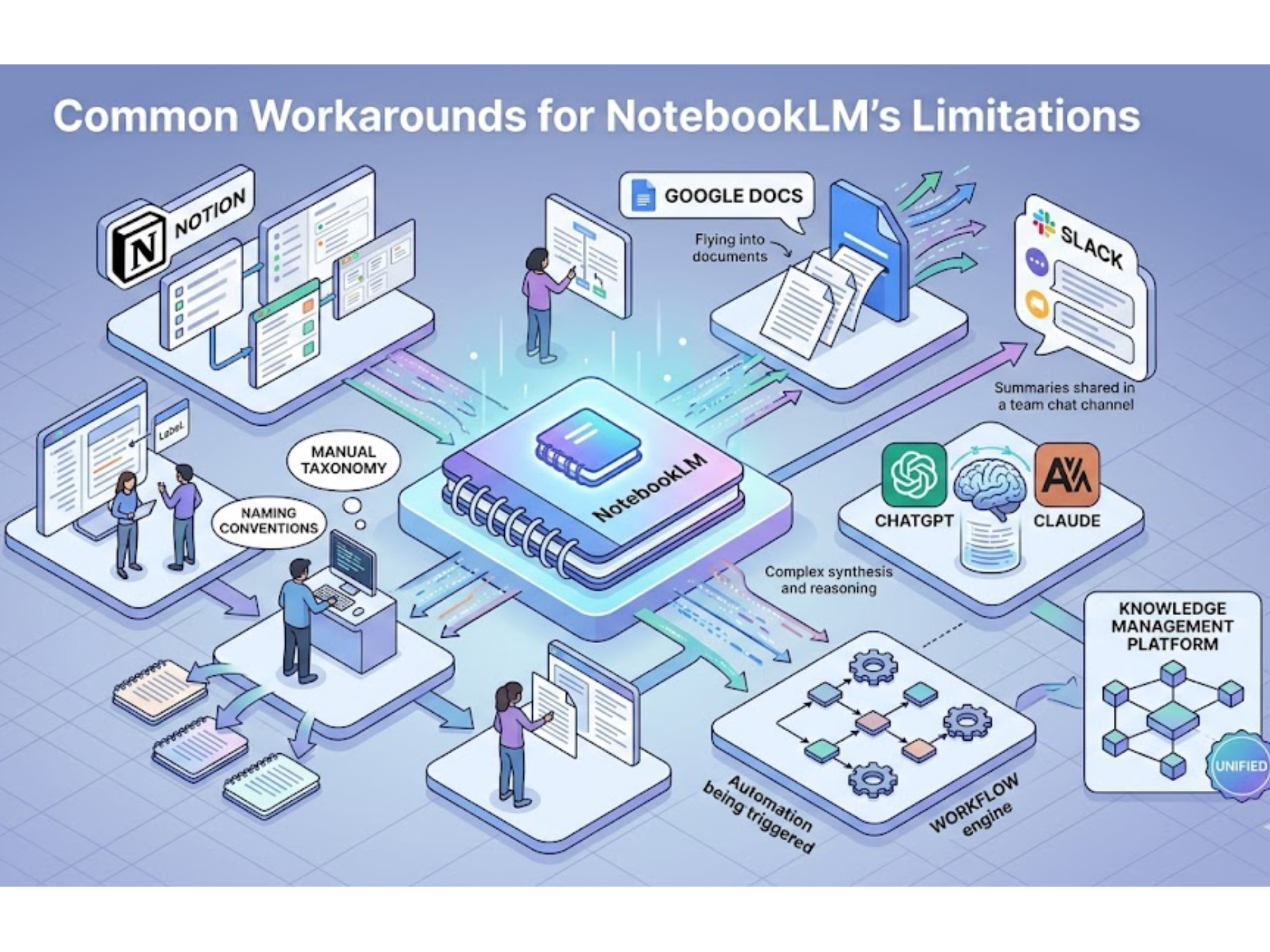
They take outputs from NotebookLM and move them into tools like Notion or Google Docs to organize and share them. They drop summaries into Slack threads. In some cases, they introduce systems like Implicit to create a more persistent, shareable layer on top of the same underlying content.
NotebookLM becomes the place where thinking begins. The rest of the stack becomes where work actually happens.
Over time, this is not a workaround. It becomes the workflow.
Users manually create taxonomy, naming conventions, and structure to stay organized
NotebookLM does not impose much structure. You upload sources, group them into notebooks, and start asking questions. That simplicity is part of what makes it so effective early on.
However, once someone starts managing multiple domains of knowledge, the absence of structure becomes more noticeable.
There is no native sense of:
- how concepts relate to each other
- how knowledge should be categorized
- how systems evolve over time
So users compensate.
They create naming conventions. They separate notebooks by function. They build informal rules about what belongs where. Some teams go further and maintain external systems in tools like Notion, or adopt platforms like Implicit that introduce taxonomy and relationships across content.
You will hear things like:
"This notebook is only onboarding material."
"That one is product documentation, do not mix them."
At that point, the user is not just interacting with knowledge. They are structuring it manually.
As content grows, users split knowledge across notebooks and lose cross-context visibility
As more content is added, the system does not break. It fragments.
Users create more notebooks to stay organized. This feels like progress. It gives a sense of control. However, knowledge does not stay neatly inside those boundaries.
Answers to real questions often span multiple domains. Product behavior might depend on training materials. Customer issues might tie back to internal documentation. When knowledge is split across notebooks, those connections become harder to surface.
So users adapt again.
They search across multiple notebooks. They re-run queries. They piece together answers manually. In some cases, they consolidate knowledge into other systems that can reason across larger sets of content more consistently, including platforms like Implicit that are designed to unify knowledge rather than segment it.
Nothing is technically broken. However, the system increasingly depends on the user to connect the dots.
Users double-check answers because outputs can miss context across documents
NotebookLM's grounding in source material is one of its strongest features. It reduces hallucinations and makes outputs easier to verify.
Even so, as users move into more complex use cases, they begin to notice something subtle. Answers are usually correct, but sometimes incomplete. They may miss a connection across documents or fail to fully synthesize information from multiple sources.
This is especially noticeable in:
- technical documentation
- multi-step reasoning
- edge cases
So a new pattern emerges.
Users ask a question, read the answer, then verify the sources. NotebookLM becomes a powerful reading accelerator. It does not fully replace the need for validation.
For many workflows, that is acceptable. For high-stakes scenarios, it introduces friction again.
Users switch to other AI tools when they need reasoning, synthesis, or decision support
NotebookLM is excellent at helping people understand information. It is less focused on helping them generate new ideas or make decisions.
When users want to go beyond explanation into synthesis or strategy, they often move to other tools. That typically means opening ChatGPT or Claude.
The workflow becomes divided:
- NotebookLM answers what the documents say
- Another model helps interpret what to do next
In some cases, users look for systems that combine these layers, grounding answers in source material while also supporting broader reasoning. This is another place where tools like Implicit enter the workflow.
The separation is not always a problem. However, it does create an extra step between understanding and action.
Teams rely on copy-paste and manual sharing because NotebookLM does not integrate into workflows
Eventually, someone asks a practical question. Can this fit into how work actually gets done?
NotebookLM is not designed as infrastructure. It does not naturally plug into workflows or operate in the background. It is a destination, not a system that integrates deeply with other tools.
So users fall back on familiar patterns:
- copying and pasting outputs
- exporting summaries
- sharing results manually
Others explore alternatives that can be embedded into workflows, whether through APIs, integrations, or internal tools. This includes building custom solutions or adopting platforms like Implicit that are designed to sit inside operational environments.
The key issue is not capability. It is placement. NotebookLM exists at the edge of workflows, not within them.
The system only improves when users continuously reorganize, curate, and rebuild context
Over time, a final realization takes shape.
NotebookLM does not naturally evolve into a long-term knowledge system. It does not automatically organize content, build relationships, or develop a deeper understanding of how information fits together.
It improves when users improve it.
They upload better documents. They reorganize notebooks. They refine how they ask questions. Some teams eventually layer on additional systems to manage knowledge more deliberately, either through structured tools like Notion or more specialized platforms like Implicit.
The result is a system that works, but only with ongoing effort.
What these behaviors actually reveal
None of this suggests that NotebookLM is flawed. In fact, it is highly effective within its intended scope.
However, users do not stay within that scope.
They begin with a simple need:
"Help me understand this information."
Then they move toward something more complex:
"Help me use this knowledge across people, systems, and decisions."
That transition introduces new requirements:
- structure
- scalability
- integration
- consistency
When those needs appear, users do not abandon NotebookLM. They surround it with other tools. They build systems on top of it. They experiment with alternatives that handle structure and delivery more explicitly.
Individually, each adaptation makes sense. Together, they point to a broader shift.
Once people trust AI to understand their information, they immediately want it to organize that knowledge, connect it, and make it usable in real workflows.
NotebookLM gets them to the starting line.
What they build next shows where things are heading.