While ChatGPT or Claude are amazing for everything, there are times when "everything" is exactly what you don't want the AI to know.
AI adoption has gone from "huh, neat" to "every team has at least three side-projects running in Notion." But with that enthusiasm comes a big, messy question nobody likes to ask out loud: Where does all this information actually go when we feed it into AI?
If your gut says, "Probably somewhere I wouldn't want my CFO or compliance officer to see," you're not wrong.
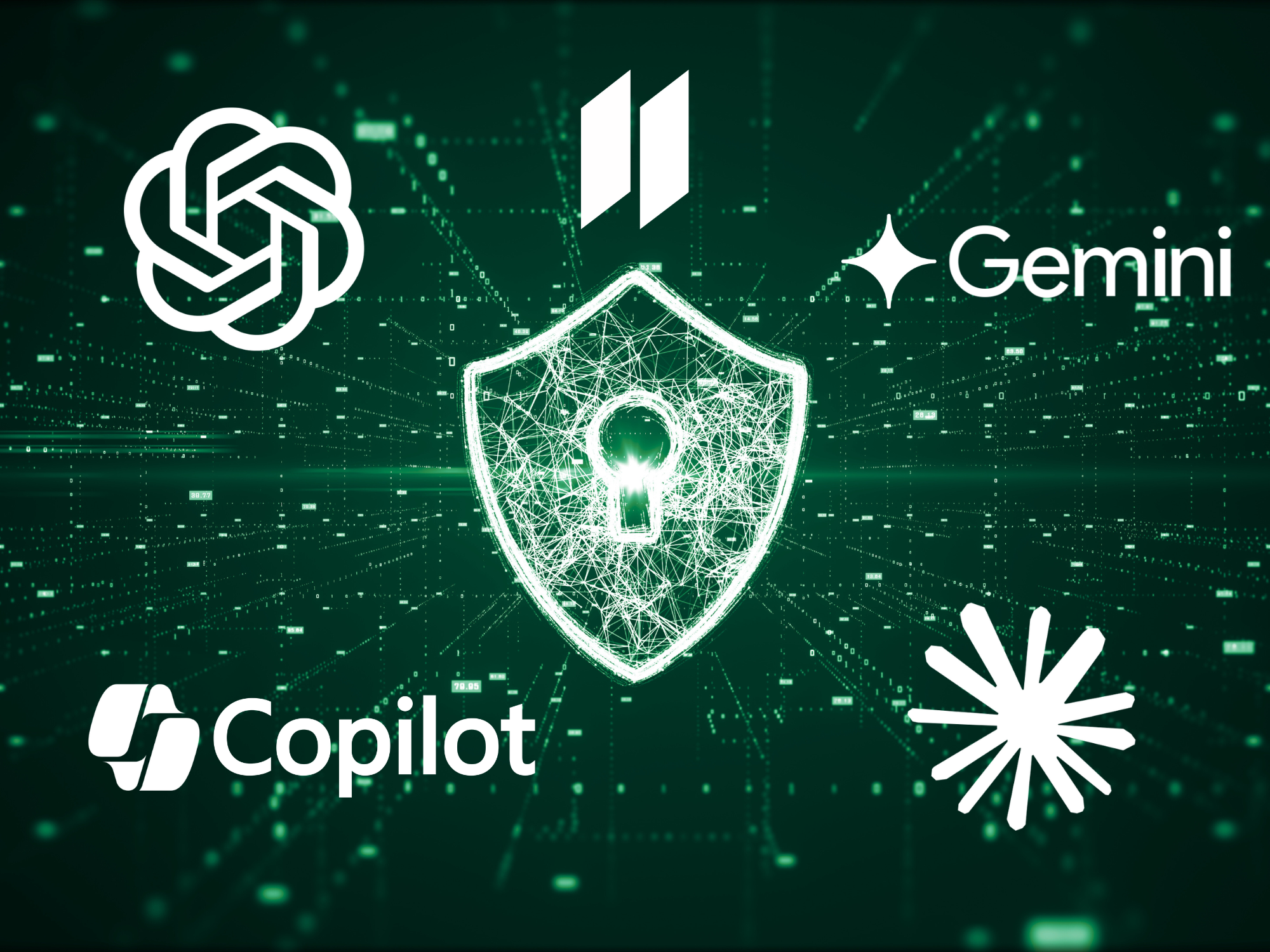
To make sense of the landscape, let's break down how the major AI platforms handle privacy, data residency, enterprise protections, and the big one: whether your information is used to train the model.
1. OpenAI / ChatGPT
Strengths
- Strong enterprise security posture (SOC 2, GDPR compliance, data encryption).
- Enterprise and Team tiers promise no training on customer data.
- Robust access controls and audit logging for larger orgs.
- Model isolation for enterprise workloads.
Limitations
- Free and Plus tiers may use data for training unless settings are explicitly changed.
- Data still flows through a centralized foundation-model system with broad model exposure.
- Limited transparency into how long certain logs are retained or how prompts are analyzed.
Best Use Case
General ideation, rewriting, coding help, lightweight research. Anything not compliance-sensitive.
2. Anthropic Claude
Strengths
- Clear stance on no training on user data, even in the consumer tier.
- Deep focus on constitutional, safe-by-design AI.
- Strong enterprise controls: SSO, audit logs, data residency options (varies by partner cloud).
Limitations
- Still a centralized foundation model.
- Limited configurability compared to a private workspace.
- Some orgs want more visibility into how Claude handles extremely sensitive document ingestion.
Best Use Case
Writing, reasoning, structured outputs, and workflows where safety and consistency matter.
3. Gemini (Google AI)
Strengths
- Enterprise data never used for training.
- Deep compliance stack thanks to Google Cloud (FedRAMP, HIPAA-eligible services in some configurations).
- Mature access control, identity, and infrastructure layers.
Limitations
- Using consumer Gemini tied to your personal Google account does not equal enterprise protection.
- Blurred line between "in the Google ecosystem" and "in the Gemini ecosystem," making some privacy-conscious orgs nervous.
- Less transparent than Anthropic about data pathways.
Best Use Case
Teams already anchored in Google Cloud looking for a familiar, tightly integrated AI layer.
4. Microsoft Copilot
Strengths
- The best option for orgs deeply embedded in Microsoft 365.
- Enterprise prompts are processed in isolated environments, with no training.
- Rich administrative controls (DLP, retention, Purview labels).
- Built on Azure OpenAI with strong compliance (FedRAMP High availability).
Limitations
- Data still flows through Microsoft's cloud. This is great for compliance, but not perfect for teams who want hard boundaries between their knowledge and Big Tech models.
- Context windows for some tasks are still evolving.
Best Use Case
Enterprise document workflows, summarizing Teams meetings, Outlook email assistance, and internal knowledge access.
5. Implicit: The Private, Secure AI Workspace
Alright, yes, this is where the cool new kid enters the cafeteria.
What Makes It Different
Unlike big LLM providers, Implicit is not a general-purpose chatbot platform. It's designed for one job: turn all of your private documents, knowledge, and expertise into a secure, accurate AI workspace where your data never becomes someone else's training material. Then, choose how you want that to manifest in terms of outputs.
Security & Privacy Posture
- Your data stays in your workspace. No training, no sharing, no background aggregation. Ever.
- Every answer cites its original source. No hallucinated facts, no guessing. Just citations tied to your uploaded docs.
- Granular workspace controls. Roles, access levels, shared vs private Navigators, workspace-level isolation.
- Deterministic pipelines. Document ingestion, transformation, embeddings, and retrieval run in a constrained, inspectable system.
- Optional siloing for sensitive verticals. (Think healthcare operations, aviation MRO, cybersecurity, federal/defense programs, etc.)
Where It Really Shines
While ChatGPT or Claude are amazing for everything, Implicit is designed for the cases where "everything" is exactly what you don't want the AI to know.
- Proprietary manuals
- Internal SOPs
- Fault logs
- Regulatory or compliance documents
- Customer data
- Recorded calls, transcripts, PDFs, knowledge bases
- Private research
- Content creators' archives (YouTube scripts, newsletters, blogs, books)
If you want AI reasoning without giving up control, Implicit becomes the "air-gapped brain" sitting on top of your content.
The Real Divide: Public vs Private AI
At the heart of this conversation is a simple truth: There is a massive difference between AI that knows "the world," and AI that knows your world.
Foundation models (ie: OpenAI, Anthropic, Google, Microsoft) are incredible engines of general intelligence. But as soon as your input becomes sensitive, regulated, proprietary, or competitive, the calculus changes.
Public LLMs give you:
- Creativity
- Reasoning
- Flexibility
- Rapid iteration
- But limited privacy guarantees unless you're on enterprise tiers
Private AI workspaces give you:
- Trust
- Auditability
- Source grounding
- Repeatability
- Controlled knowledge boundaries
- Full ownership of your domain expertise
Many modern orgs end up with a hybrid strategy: Public LLMs for creativity. Private AI workspaces for mission-critical work.
Final Thought: Privacy Isn't a Feature. It's a Foundation.
AI is becoming the default interface for how we interact with information. Not "a tool," but the tool.
And the companies who treat privacy as a bolt-on checkbox won't win this era. The ones who treat it as a first-principles design constraint will.
Tools like ChatGPT, Claude, Gemini, and Copilot all have their place. But if your data is your advantage (and let's be honest, for most organizations it absolutely is) you'll need an AI system that respects that advantage instead of consuming it.
That's where private, secure workspaces like Implicit aren't just helpful. They're inevitable.